


The DORI Standard (Detect, Observe, Recognize, Identify) is one of the most powerful tools a security dealer can use—but most aren’t using it. Why? Because the numbers (like “250 pixels per meter”) can feel too technical, and let’s face it—your clients just want to know if a camera can catch a license plate or see a face clearly. This post breaks it down in plain English so you can confidently specify the right cameras, justify your design choices, and explain to your customers what they’re really getting for their investment.
What Is the DORI Standard?
The DORI standard is a guideline defined by the European EN 62676-4 spec. It breaks camera performance into four levels of image detail:
-
Detect – Can I tell something’s there?
-
Observe – Can I see what’s happening?
-
Recognize – Can I tell who it is if I already know them?
-
Identify – Can I prove exactly who it is?
Each level corresponds to how many pixels are captured across each meter (or foot) of the scene. Think of it as a “clarity scale” based on pixel density.
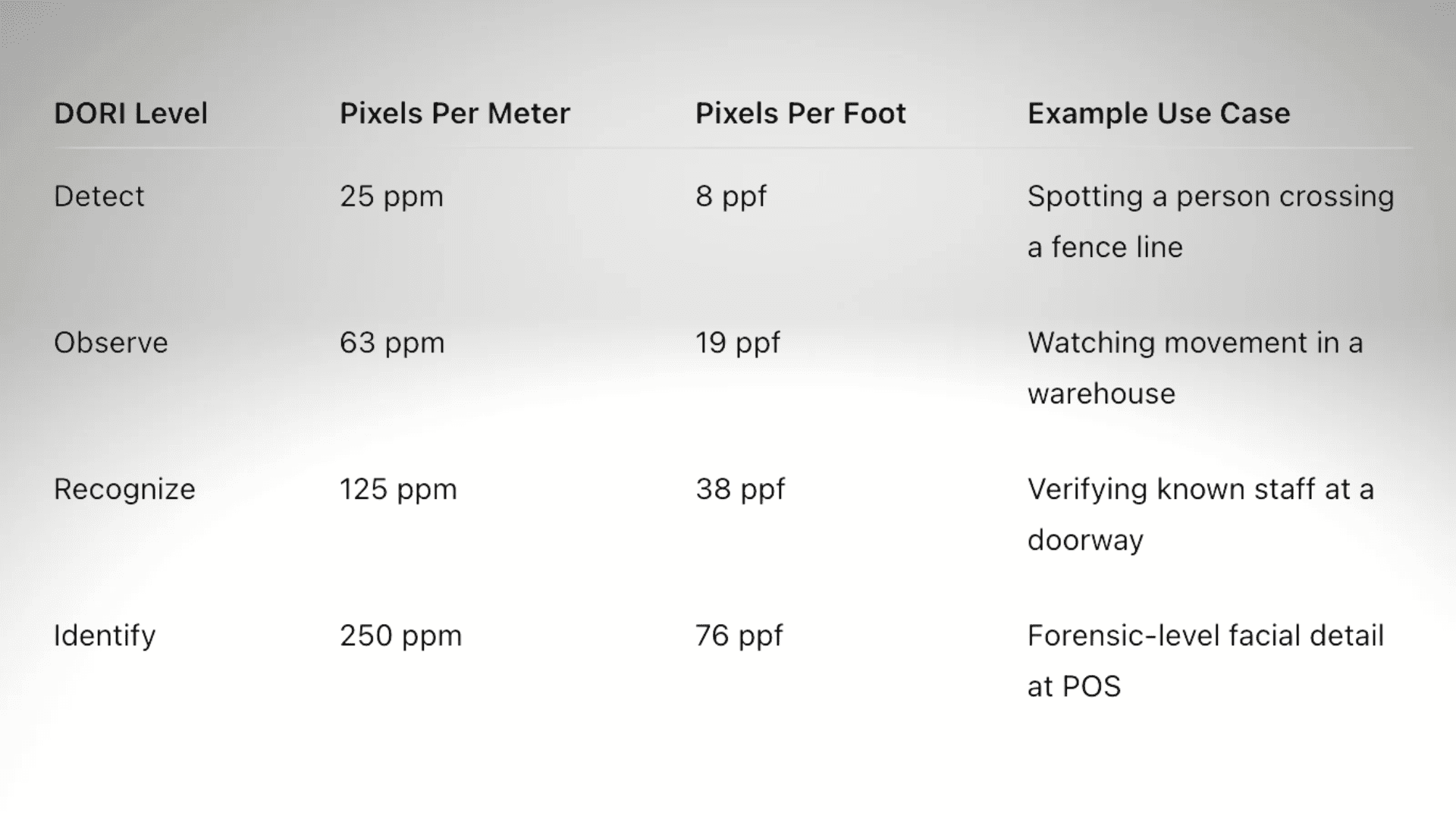
As a dealer, using these levels helps you spec the right camera with the right lens at the right distance. It also gives you a professional framework to explain why one design costs more—or performs better—than another.
Why This Matters to Your Clients
Most end users don’t know how to evaluate a camera. They’ve heard buzzwords like “4K” or “HD,” but those mean nothing if the camera’s too far away or installed at the wrong angle. The DORI standard turns camera selection into a clear conversation about results.
Here’s how you can explain it to your clients:
-
“If you want to see if someone is there, we need at least 25 pixels per meter—this is the Detect level.”
-
“If you want to see what they’re doing, you need about 63 ppm—this is Observe.”
-
“If you want to know who it is if it’s someone you know, then we need 125 ppm—Recognize.”
-
“And if you want to ID someone clearly for evidence, that’s 250 ppm—Identify.”
You’re no longer just selling “a 5MP camera”—you’re selling the right image quality for the job.
Practical Use Cases: Where DORI Helps You Sell
Let’s say your client owns a small business with the following requirements:
-
Parking lot perimeter – You spec a wide-angle camera that hits the Detect level at the lot edge. It lets them know if someone enters the area.
-
Front entrance – You install a camera that reaches the Identify level at the door. Perfect for forensic facial capture.
-
Warehouse interior – A camera that meets the Observe level helps monitor employee movements and behavior.
This approach helps clients understand why one area might need a higher-resolution camera (and budget) while others don’t. It also sets realistic expectations. If a customer says, “I want to read license plates from 100 feet away,” you can calculate whether that’s possible based on DORI.
Benefits for Dealers: Look Like a Pro, Sell Like a Pro
-
Justify the Upgrade: Instead of pushing a 4K camera “just because,” explain the specific performance level it achieves based on DORI.
-
Stand Out from Competitors: Most integrators don’t explain camera performance this way. You’ll look like an expert.
-
Reduce Callbacks: Set clear expectations by matching camera specs to application needs. No more “I thought the image would be clearer” complaints.
-
Streamline Design: Use the DORI framework in your site surveys to simplify system layouts and avoid overdesign.
Optional Technical Summary for Dealers
Here are the DORI pixel density targets to remember:
-
Detect: 25 pixels/meter (8 pixels/foot)
-
Observe: 63 pixels/meter (19 pixels/foot)
-
Recognize: 125 pixels/meter (38 pixels/foot)
-
Identify: 250 pixels/meter (76 pixels/foot)
Use these numbers along with your camera’s resolution and lens specs to calculate DORI distances. Most VMS platforms and camera calculators include DORI estimates as part of their design tools.
Use DORI to Deliver Clarity and Confidence
The DORI standard gives security professionals a reliable, industry-accepted way to match performance to purpose. As a dealer, this means more than just choosing hardware—it means guiding your clients to the right decision using measurable, professional criteria.
And for your clients, it means no more guessing. With DORI, they’ll know what their cameras can actually do—and trust that you’re the expert who helped them get there.
Partner with SESP for Smarter Surveillance System Design
Southeast Security Products represents best-in-class surveillance and access control manufacturers across the Southeast U.S., helping dealers deliver better results through expert support and professional tools. Whether you’re upgrading an outdated analog system or designing a new camera layout for a high-security site, our team can help you match DORI specs to real-world performance and get the most from your gear.
Visit sesproducts.com or contact us today to request support, demo tools, or camera selection help for your next surveillance project.