


In the world of IP video surveillance, timing is everything—especially when it comes to visibility in low-light or no-light conditions. That’s where IR illumination comes in. If you’ve ever had a customer ask, “Will this camera see anything at night?”—this is the section of your training that provides the answer. Understanding when and how infrared (IR) illumination should be used gives dealers and technicians a major edge when designing reliable, 24/7 video coverage.
What Is IR Illumination and Why Does It Matter?
IR (Infrared Radiation) Illumination is used in surveillance systems to provide visibility in darkness without using visible light. Most modern outdoor cameras come equipped with IR as a standard feature. These cameras remove the IR cut filter when the scene gets dark and flood the area with infrared light, allowing the camera to capture sharp black-and-white footage even in total darkness.
This technology is essential in countless scenarios—from perimeter surveillance to license plate recognition—because it allows the system to function consistently around the clock.
Understanding IR Wavelengths: 850nm vs. 940nm
There are two main wavelengths used in IR illumination:
-
850nm – The most commonly used wavelength. While technically invisible, it emits a faint red glow at the source. It’s more powerful and provides better range and illumination.
-
940nm – Considered covert because it produces no visible glow at all, making it ideal for applications requiring stealth. However, it has shorter range and is slightly less powerful.
Security professionals must choose based on the use case. For example, 850nm is great for outdoor long-range use, while 940nm might be preferred indoors or for sensitive surveillance scenarios.
Built-in vs. External IR Illumination
Most integrated IR cameras have LEDs built directly into the housing. These built-in IRs work well for general applications, but they aren’t without limitations:
-
Hot spots and uneven lighting
-
Shorter range
-
Susceptibility to dirt, spider webs, or bugs causing IR bounce-back
That’s where external IR illuminators come into play. They provide:
-
Greater distance coverage
-
More uniform illumination
-
Flexible positioning
When designing systems that need dependable nighttime visibility over long distances, such as perimeter fencing or wide open spaces, external IR is a far better option.
Video: A spider can quickly render a camera useless at night
Real-World Example: DW NightWatch IR Illuminators
Digital Watchdog offers a powerful line of external IR illuminators through its NightWatch™ series, such as the DW-ILIRIP850. This unit offers:
-
PoE-powered 850nm IR illumination
-
Up to 614 ft of coverage
-
Software-based configuration
-
Field-swappable lenses for 30°, 60°, or 95° beam angles
-
Tight integration with DW Spectrum® IPVMS
The ability to match IR coverage precisely to the camera’s field of view means more accurate lighting and fewer blind spots—something integrated IR simply can’t guarantee.
IR Distance and Beam Coverage
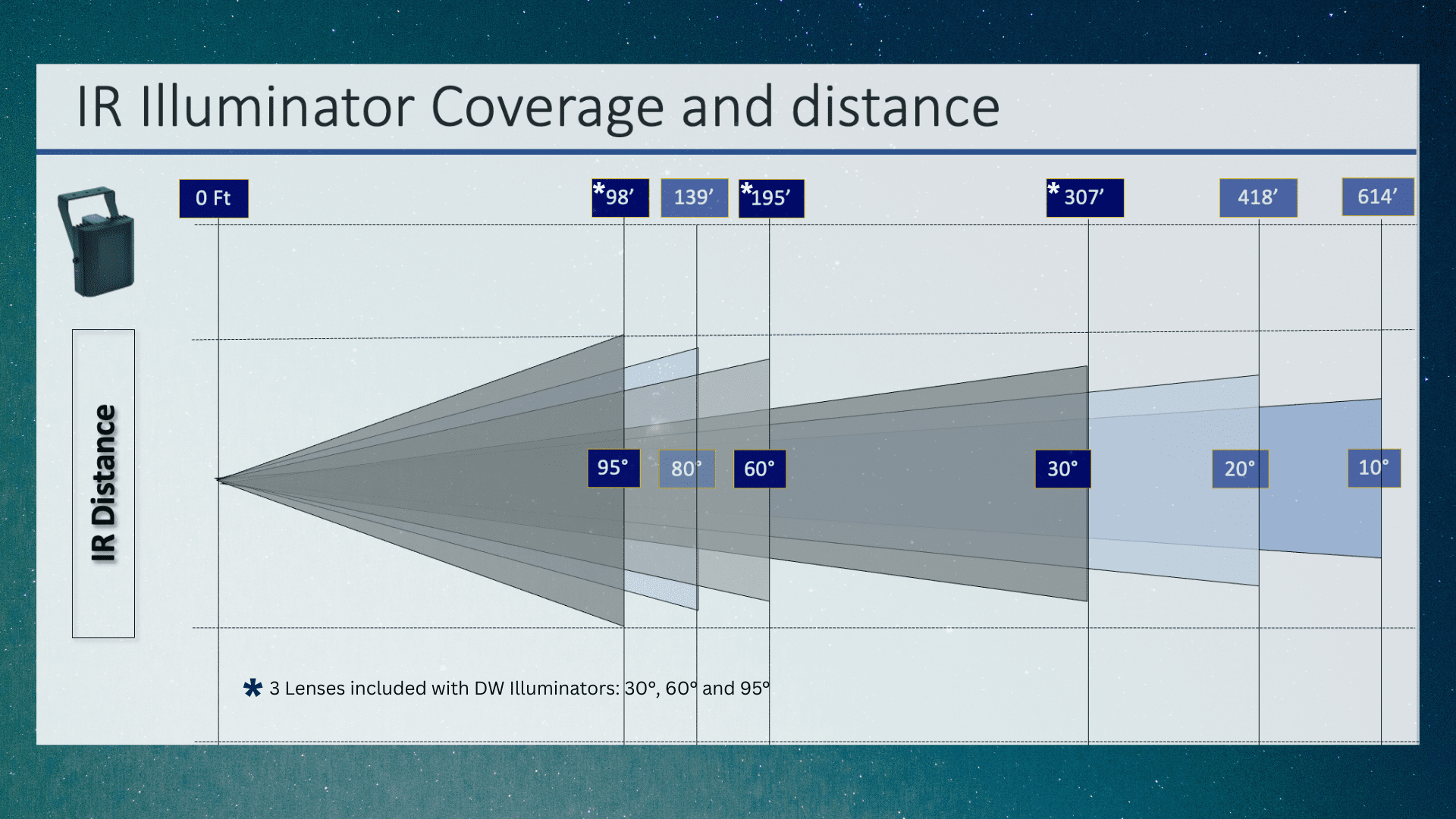
Not all IR illumination is created equal. One of the most overlooked aspects is beam angle vs. distance. Narrow beam angles (e.g., 30°) push light farther, ideal for long-range applications like gates or driveways. Wider angles (e.g., 95°) light up a broader area, useful for parking lots or loading docks.
The image below on IR coverage demonstrates how different angles correlate with coverage distance:
-
30° = Up to 614 ft
-
60° = Moderate distance
-
95° = Wide but short-range coverage
Dealers should always consider:
-
The lens angle of the camera
-
The area being monitored
-
The details that need to be captured (e.g., facial ID vs. general motion)
What Do You Want to See?
When selecting IR illumination, it’s not just about lighting up a space—it’s about identifying what the user wants to see. The IR coverage must match the desired detail:
- Detection: General field coverage
- Observation / Situational Awareness: Wide, even IR spread
- Recognition: Uniform, mid-range lighting
- Identification / License Plate Reading: Directional and powerful IR
Knowing this helps you engineer systems that align with your customer’s expectations and avoid false assumptions about what a camera can really see at night.
White Light vs. IR Light
There are some situations where white light illumination may be preferred:
-
Color image is required
-
Scene needs to trigger as if it’s daytime
-
User wants visible deterrence
White light can also be controlled by PIR sensors or system triggers to avoid constant illumination. It’s a great tool when motion-activated lighting is needed in addition to surveillance.
IR Integration with DW Spectrum® IPVMS
DW’s NightWatch IR illuminators are IP programmable and fully integrated with DW Spectrum® IPVMS, allowing for:
-
On-motion activation
-
On-analytics events
-
Soft-trigger integration
-
Remote configuration and status monitoring
This creates an intelligent ecosystem where lighting is controlled contextually—not just on a schedule or hardwired trigger. That’s a major win for dealers looking to offer high-end, automated video solutions.
Partner with SESP for Your IP Video and Illumination Applications
Southeast Security Products represents Digital Watchdog and other best-in-class manufacturers across the Southeast U.S., offering hands-on support, product expertise, and dealer-focused programs to help you grow your business. Whether you’re building your first smart home package, upgrading to next-gen connectivity, or integrating high-performance technology into a larger security system, we can help you select the right solutions to power your installations. Contact us today for pricing, training, or to request a demo of the DW NightWatch™ IR Illuminators.
Visit sesproducts.com or reach out to learn more about how we can support your next project.