

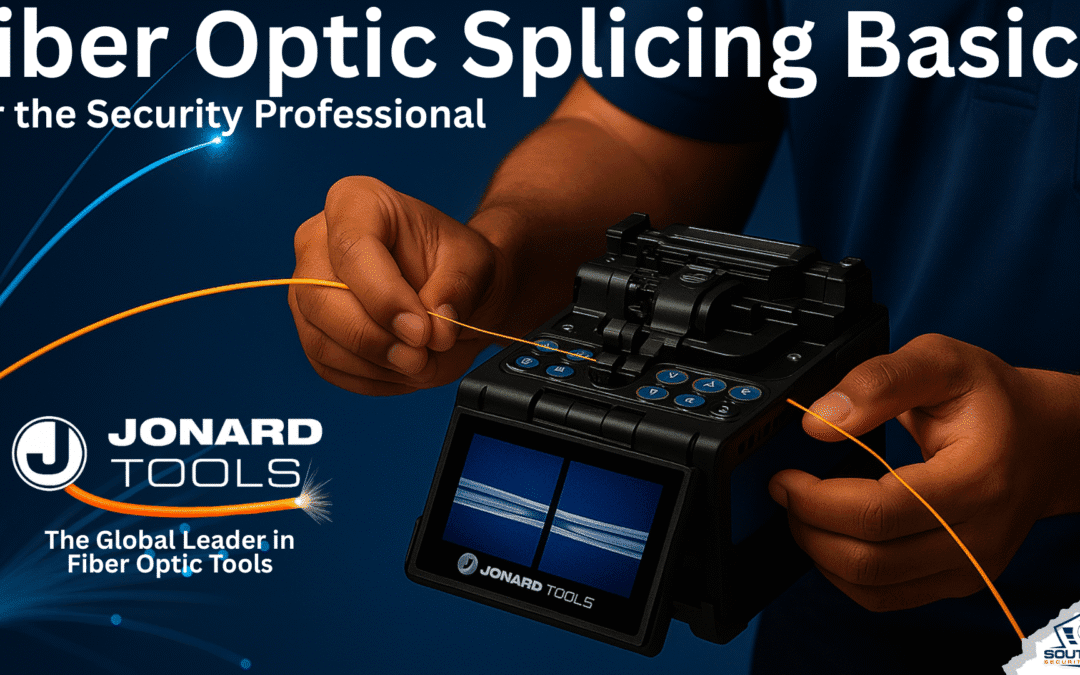
Fiber Optic Splicing is becoming increasingly relevant to security dealers as more IP surveillance and access control systems rely on high-speed, long-distance connections. Traditionally, many dealers have outsourced fiber work or relied on pre-terminated cables, assuming splicing was too complex or required expensive equipment. But today’s compact, dealer-friendly fusion splicers—especially the SPARC line from Jonard Tools—are changing the game, allowing integrators to take control of their own fiber installations.
Whether connecting IP cameras to a PoE switch, linking remote access control panels, or tying buildings together on a larger campus, fiber optic cable is unmatched for speed, range, and reliability. And understanding the basics of fiber splicing can help you trim costs, increase flexibility, and take your installation capabilities to the next level.
Why Splice Instead of Use Pre-Terminated Fiber?
Pre-terminated fiber cables offer convenience but come at a cost. These cables often require precise measurements ahead of time, limited flexibility in the field, and significant markups from manufacturers or distributors. They also create waste, as unused lengths can’t always be repurposed.
In contrast, fusion splicing allows you to custom-fit fiber to any job. It eliminates excess slack, avoids long lead times, and dramatically reduces per-foot costs. With the right tools and a bit of training, fiber optic splicing becomes a cost-effective and highly controllable part of your workflow—especially when using rugged, field-ready kits like Jonard Tools’ SPCL-1, SPCL-2, or SPCL-3.
Two Types of Typical Fiber Alignment in Fusion Splicing
Understanding alignment methods is one of the first parts in understanding fiber optic splicing. The alignment process determines how accurately two fiber ends are positioned before they’re fused together, which affects signal quality, splice loss, and long-term reliability.
1. Clad Alignment
Clad alignment fusion splicers align fibers using their outer cladding, assuming the core is centered within. This is the simplest and most affordable method, making it ideal for shorter runs or uniform fiber types. However, it’s less forgiving of variations in core placement or geometry. Ideal for IP Camera and Network applications
2. Core Alignment
Core alignment uses high-magnification cameras and motorized actuators to precisely align the fiber cores before fusion. This results in lower splice loss and better optical performance, especially important in longer runs, mixed fiber types, or bandwidth-heavy systems like 4K video surveillance.
How Fiber Optic Splicing Works: Step-by-Step
To give security dealers more confidence in tackling fiber themselves, here’s a breakdown of the splicing process:
- Prepare the Cable
Strip the outer jacket, buffer tube, and coating using fiber stripping tools. - Clean the Fiber
Use lint-free wipes and isopropyl alcohol to clean the exposed glass. - Cleave the Fiber
A precision cleaver is used to create a flat end face, critical for a quality splice. - Load the Fibers into the Splicer
Place each fiber in the machine’s holders or v-grooves. The machine will inspect and align them. - Fusion Splice
The splicer uses an electric arc to melt and fuse the fiber ends together. - Protect the Splice
Slide a heat shrink sleeve over the splice and use the built-in oven to secure it. - Test the Connection
Use a visual fault locator (VFL) or OTDR tester to check for signal loss or errors.
With modern tools like Jonard’s SPARC series, this process takes only a few minutes per splice—and gets faster with practice.
Why Fiber Is Ideal for Security Applications
Fiber offers several advantages that make it the preferred medium for many modern surveillance and access control systems:
- Extended Range – Fiber runs can easily exceed 1,000 feet, far beyond the 328-foot limit of Cat6 cable.
- High Bandwidth – Ideal for high-resolution camera streams and networked devices.
- EMI Immunity – Fiber doesn’t carry electrical current, making it immune to electromagnetic interference from motors, lighting, or high-voltage lines.
- Lightning Resistance – Unlike copper, fiber won’t conduct electricity, reducing risk in outdoor and pole-mounted deployments.
Whether you’re setting up a surveillance camera at the edge of a parking lot or connecting buildings across a corporate campus, fiber gets the job done reliably.
Jonard Tools SPARC Fusion Splicer Lineup
Jonard Tools has engineered a powerful and portable lineup of splicers designed for field use:
- SPCL-1 Clad Alignment Fusion Splicer
Uses Active V-Groove Clad Alignment with removable v-grooves, a great entry-point between performance and affordability. - SPCL-2 Core Alignment Fusion Splicer
Core alignment precision for critical fiber installs or long-distance applications. - SPCL-3 Core Alignment with Large Screen
Enhanced usability with a larger screen, battery life, and splicing stats logging.
All models come in complete kits with cleavers, strippers, VFLs, cleaning tools, ovens, and rugged carry cases.
Key Terminology Every Security Dealer Should Know
Understanding these key terms can help you communicate more confidently with your team and clients:
- Fusion Splicing – The process of permanently joining two fiber ends using heat.
- Cladding – The protective optical layer surrounding the core that guides light.
- Core – The center of the fiber where light travels.
- Cleaver – A tool that makes a clean, perpendicular cut across the fiber.
- Splice Loss – The amount of optical power lost at the splice point.
- OTDR (Optical Time-Domain Reflectometer) – A diagnostic tool that maps out splice performance and faults.
- Single-mode vs. Multi-mode – Single-mode is better for long distances; multi-mode is more common in short runs.
- Insertion Loss – The signal power lost due to a connection or splice.
- EMI (Electromagnetic Interference) – Noise from electrical equipment that fiber is immune to.
Related Fiber Tools from Jonard
To get the job done right, here are a few essential tools to pair with your splicer:
- FCT-100 Fiber Cleaver – High-precision cleaving for accurate, low-loss splices.
- JIC-375 Fiber Optic Stripper – 3-hole stripper for outer jacket, buffer, and coating.
- VFL-25 Visual Fault Locator – Quickly identifies fiber breaks and poor splices.
- FCS-25 Fiber Connector Cleaner – For cleaning fiber end-connectors.
These tools work seamlessly with Jonard’s SPARC kits and are readily available through your preferred low-voltage distributor.
Final Word: Stop Outsourcing, Start Splicing
Security professionals are already trusted to install and maintain complex IP-based systems. Adding fiber splicing to your skillset not only reduces cost and wait time but also gives you full control over every part of the job. With Jonard’s SPARC series of splicers and fiber tools, you have everything you need to handle fiber in-house.
Don’t let the learning curve keep you from the revenue opportunity. Mastering fiber optic splicing basics is easier than you think—and it could be one of the best upgrades your team makes this year.
Partner with SESP and Jonard Tools for Your Fiber Optic Installations
Southeast Security Products represents Jonard Tools and other best-in-class manufacturers across the Southeast U.S., offering hands-on support, product expertise, and dealer-focused programs to help you grow your business. Whether you’re building your first smart home package, upgrading to next-gen connectivity, or integrating high-performance technology into a larger security system, we can help you select the right solutions to power your installations. Contact us today for pricing, training, or to request a demo of the Jonard Tools SPCL-1 Fusion Splicer.
Visit sesproducts.com or reach out to learn more about how we can support your next project.